
Parma, 15-20 September 2025
Artistic direction
Daniele Albanese
Promoted by Europa Teatri
with the patronage of the Municipality of Parma
with the contribution of Fondazione Cariparma
in collaboration with
Library System of the Municipality of Parma
Network Anticorpi XL, Museum of Chinese and Ethnographic Art of Parma
Parma Moving Festival, the festival of dance and performing arts in the city’s public spaces, entitled Solo cose belle (Only beautiful things), is now in its third edition. It will take place in Parma from 15 to 20 September, under the artistic direction of Daniele Albanese, promoted by Europa Teatri, organised with the patronage of the Municipality of Parma, with the contribution of Fondazione Cariparma, in collaboration with the Library System of the Municipality of Parma, the Museum of Chinese and Ethnographic Art of Parma and Network Anticorpi XL.
Performances, site-specific creations and seminars make up the programme of the Festival, which was born out of a desire to bridge the gap between the public and the languages of contemporary dance, which in turn are transformed, crossing and inhabiting unusual spaces with new ways of staging performances. For this new edition, which features some of the most interesting artists on the Italian scene known for their refined artistic research, the shows will be scattered throughout the city’s squares and open-air venues (Piazza Garibaldi, Piazzale F. Borri, Piazza Ghiaia, Piazzale Picelli), as well as in the spaces of the Chinese and Ethnographic Museum and in libraries with events at the Civic Library/Oratorio Novo and the Malerba Library. At the same time, the Teatro Europa will also host several events, all aimed at giving new meaning to the theatre space, opening it up to new possibilities for viewing and enjoyment.
“Parma Moving Festival wants to reflect on this art form, on the possibility of encountering the community and rethinking the paradigm of possible enjoyment, also in light of recent ministerial cuts that have severely penalised the sector,” says artistic director Daniele Albanese. “This edition, even more so than in previous years, is set in that borderline place, understood as a place of turbulence but also of encounter and exchange, between the lightness and entertainment of dance and thought. Taking its cue from the title of one of the scheduled events, Coreografie del pensiero e della gestualità (Choreography of Thought and Gesture) is a perfect summary of this year’s edition, and Border is the keyword that accompanies it”.
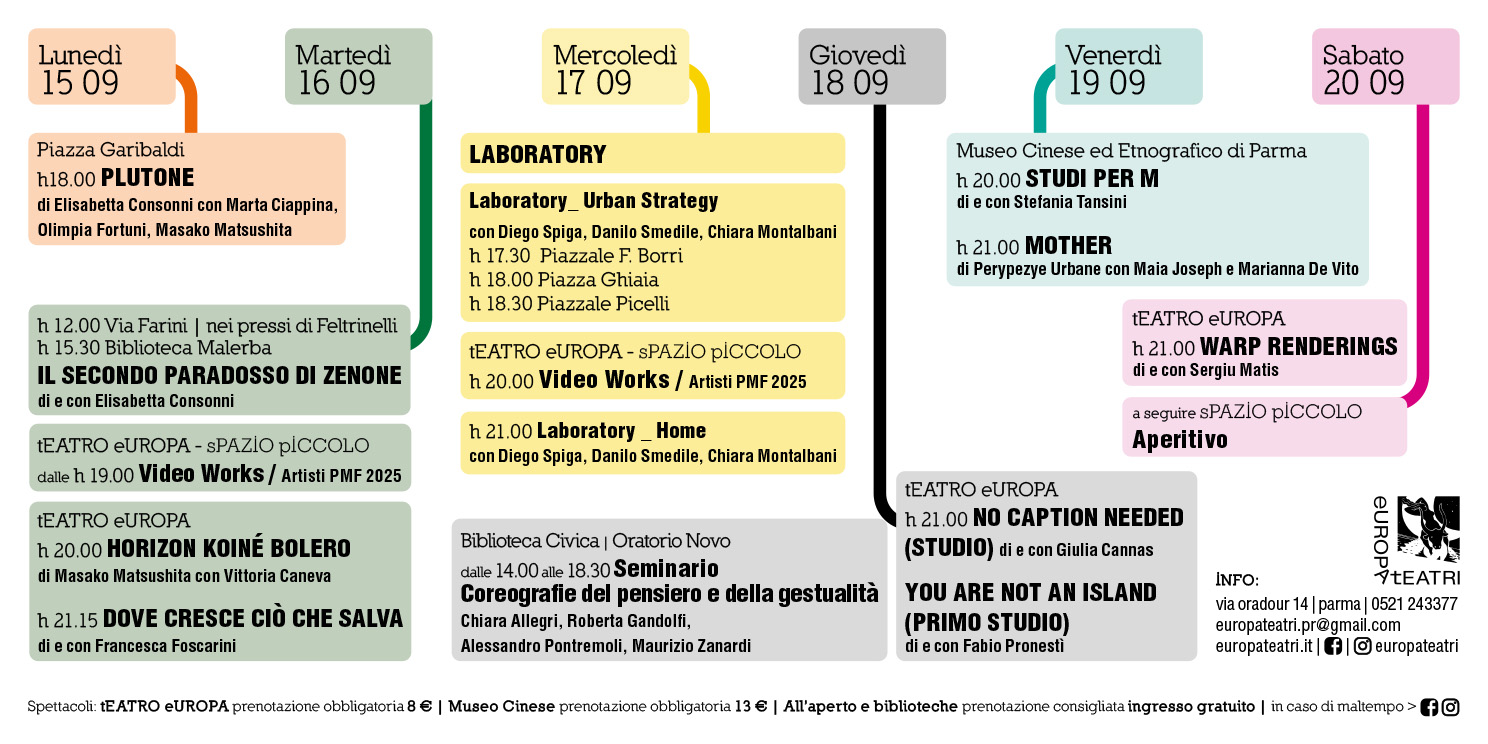
Elisabetta Consonni will open the Festival on Monday 15 September at 6 pm in Piazza Garibaldi with Plutone, featuring three outstanding performers: Marta Ciappina, Olimpia Fortuni and Masako Matsushita. An artist trained in Italy and abroad (Poland, Holland and at The Place in London), Elisabetta Consonni choreographs everything, human and non-human beings, movable and immovable objects, maps, interstices and space holiday groups. Her research focuses on how performing arts can provide tools for urban and social policies. Plutone, a historic show from 2012, was born from a meditation on the idea of the centre as a constantly changing entity. It is a choreographic composition that explores and provokes the centrifugal and centripetal relationships of three bodies in constant orbital motion in space, a reflection on cooperation and the delicate fragility of harmony.
On Tuesday, 16 September, Elisabetta Consonni will present, in Via Farini (at 12 noon), near the Feltrinelli bookshop, and at the Malerba Library (at 3.30 p.m.), Zeno’s Second Paradox, loosely based on the mathematical paradox of Achilles and the tortoise: a very slow spatial crossing by an astronaut, the slow-motion walker par excellence, from one point in the urban landscape to another. The performance is a celebration of slowing down, a form of resistance against the rhythms of a system of production and consumption that always wants more and faster. It is the realisation that even a slow movement can lead to a goal, without making us lose the experience of the journey. As with Pluto, this work also refers to an Elsewhere, to other planets, other ways, other atmospheres.
On the same day, at 8 p.m., the Teatro Europa hosts two works that, in different ways, explore the identity and languages of dance.
Horizon Koinè Bolero by Italian-Japanese multidisciplinary artist Masako Matsushita, who analyses movement through research processes, choreographic projects, performance installations and community interaction. Performed by Vittoria Caneva, it is a reinterpretation of Maurice Ravel’s famous Bolero, capturing its multiplicity and vitality as a synonym for universal dance, the embodiment of a union between different artistic expressions and cultures. It is a common horizon, a meeting point where the distinctive features of each tradition merge into a single language, capable of transcending space and time. At 9.15 pm, Francesca Foscarini presents Dove cresce ciò che salva (Where that which saves grows), an intense solo that shows the dark aspects of the creative process. A quest that, out of necessity and desire, unfolds entirely outdoors, in the open, right where that which saves grows. There, where stones – the bones of the earth, the skeleton of the world – become the archive of the forces that compose and decompose life. It is on this enigmatic presence/absence that the artist’s journey is mapped out, in a difficult attempt to recover lost biological memory and where, perhaps, it is possible to reconnect with the universe.
On both days, 16 September from 7 p.m. and 17 September from 8 p.m., at the Teatro Europa, visitors will be able to view Video Works, short video pieces by the artists participating in the Festival, to learn more about them.
Three actions in three public spaces in the city: this is the Laboratory project, structured in two different forms with choreographic actions by dance authors Chiara Montalbani, Danilo Smedile, and Diego Spiga.
Laboratory_Urban Strategy will take place on Wednesday 17 September in locations in the historic centre – P.le F. Borri (5.30 pm), Piazza Ghiaia (6 pm), P.le Picelli (6.30 pm). The three artists, renowned performers on the Italian scene, will offer different languages, united by their great technical skills and keen sensitivity to space. Their improvisations will help us to see the city’s spaces with new eyes. At 9 p.m., the same artists, in Laboratory_Home, will inhabit the spaces of the Teatro Europa with improvisations.
On Thursday, 18 September, from 2 p.m. to 6.30 p.m., at the Oratorio Novo of the Civic Library, a seminar open to the public will be held, entitled Choreography of Thought and Gesture, with presentations by Chiara Allegri, professor of cultural events marketing at the University of Brescia; Roberta Gandolfi, professor of contemporary theatre history at the University of Parma; Alessandro Pontremoli, full professor of performing arts at the University of Turin; and philosopher Maurizio Zanardi, reflecting on contemporary dance, its languages and identity.
At 9 pm at the Teatro Europa, two young Italian choreographers will present two solos. Emerging Sardinian choreographer Giulia Cannas, author, performer and dancer interested in dance as a manifestation of existence, presents No Caption Needed, a study that defines the body as a threshold and boundary, an investigation that moves from themes of marginality, exploring the body as a border space and bridge to the margins, whose features she deconstructs and rewrites. Turin-based Fabio Pronestì, with his first study You Are Not an Island, places the body in a more extensive mapping of experiences and memories, suggesting glimpses of light on the system of family constellations, a tool of investigation aimed at revealing a legacy of affective memories and transgenerational entanglements.
On Friday 19 September, at 8 pm, Parma Moving Festival moves to the Chinese and Ethnographic Art Museum where Stefania Tansini, one of the most highly regarded choreographers in Italian contemporary dance in recent years and winner of several awards (including the 2022 Ubu Award for Best Performer Under 35), with Studi per M, presents a project that explores the relationship between bodies, perception and places, which will come to life perfectly in its site-specific dimension, adapting and transforming the museum spaces in the audience’s view. The project aims to open up the subjects and observe their interior, juxtapose and sew together pieces of reality, and experience dance as a tool closer to the unspoken that bodies emanate and places conceal.
At 9 p.m., Mother by Perypezye Urbane, curated by Giovanni Sabelli Fioretti, with Maia Joseph and Marianna De Vito, explores the intersection between different languages, focusing on the figure of the mother as a metaphor for the generative body par excellence, comparing it with so-called generative Artificial Intelligence, giving rise to a work on and with Artificial Intelligence to investigate its aesthetics and limits. The soundtrack itself is an original creation made using AI through a mix of software.
The Festival concludes on Saturday 20 September at 9 p.m. at the Teatro Europa with Romanian artist Sergiu Matis, from the Berlin scene, with his solo Warp Renderings, in which he explores how aestheticised images of landscapes have distorted contemporary society’s relationship with the natural world, from the traditions of European landscape painting to photography, satellite images, CGI and virtual reality. The Festival will conclude with a farewell aperitif.